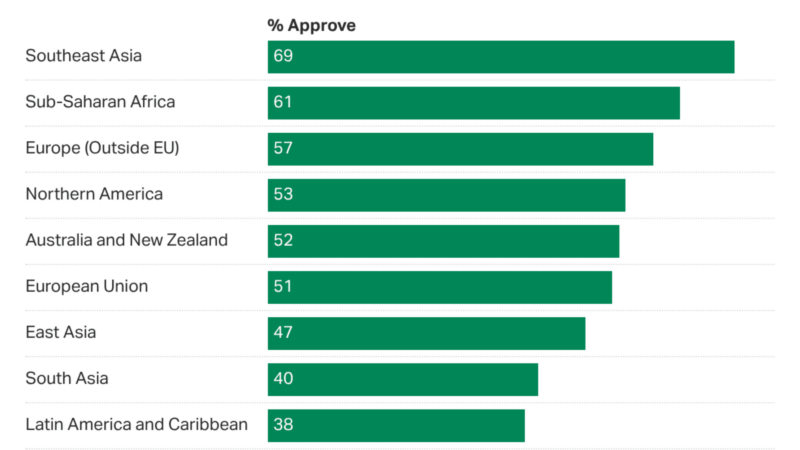
Across 137 countries surveyed in 2025, median approval of the United Nations’ job performance is 50%, compared with 26% median disapproval, for a net approval score of +24. Approval exceeds disapproval by at least 10 percentage points in 92 countries, while majorities disapprove in nine.
More Context: In a separate question about individual country leadership, median approval ratings for Germany (48%), China (36%), the United States (31%) and Russia (26%) are all lower than the UN’s 50% median approval as an organization. China, the U.S. and Russia are permanent members of the UN Security Council.
The Data: Approval of the United Nations exceeds disapproval in 10 of 11 regions, led by Southeast Asia with an overall approval rating of 69%, far exceeding 18% disapproval, resulting in a net approval of +51.
Regional Outlier: The Middle East and North Africa is the only region where disapproval is substantially higher than approval, with 23% approving of the UN's job performance and 46% disapproving, resulting in a net approval of -23.
3. The UN, Rated by Its Security Council Member States
The Data: Among the current UN Security Council member states interviewed in 2025, approval of the UN ranges from 79% in Denmark and 76% in Liberia to 22% in Pakistan and 15% in Russia.
Permanent Members: Approval differs sharply among permanent Security Council member states. Approval is 59% in the United Kingdom and 55% in the United States, compared with 38% in France and 15% in Russia. China was not asked the question in 2025.
The Data: Democrats are far more positive than Republicans about the United Nations across a range of questions. For instance, 70% of Democrats say the UN plays a necessary role in the world today, compared with 40% of Republicans.
Party Divide: Republicans are especially critical of the UN’s performance and funding. Seventy-five percent say it is doing a poor job, and 70% favor decreasing U.S. funding. Independents are closer to Republicans than Democrats on job performance but more supportive of the UN’s broader role.
The Data: Gallup asked Americans to rate the United Nations’ job performance in five areas. Forty-five percent say the UN is doing a good job delivering humanitarian assistance to people affected by war, famine or natural disasters, the highest rating among the five areas measured.
Across Areas: Thirty-four percent of Americans say the UN is doing a good job supporting sustainable development. Smaller shares say the same about protecting human rights (28%), upholding international law (28%), and maintaining international peace and security (25%).
6. 1937: Americanos rejeitam adesão à Liga das Nações.
Os dados: Em uma pesquisa Gallup de outubro de 1937, 53% dos americanos disseram que não queriam que os Estados Unidos se juntassem à Liga das Nações, enquanto 26% eram a favor da adesão e 21% não tinham opinião formada.
Contexto histórico: A Liga das Nações, criada após a Primeira Guerra Mundial para promover a cooperação internacional e a paz, serviu posteriormente como precursora das Nações Unidas. Os Estados Unidos nunca aderiram à Liga. Os resultados de 1937 refletem a resistência pública aos compromissos internacionais que existia nos EUA durante o período entre guerras.